Importing packages & modules
[1]:
import sys
import pandas as pd
import numpy as np
from sklearn.preprocessing import StandardScaler

# Add parent directory to sys.path to import tsad modules
sys.path.insert(1, '../')

# Import custom modules
from tsad.base.pipeline import Pipeline

# Import tsad tasks for pipeline
from tsad.tasks.eda import HighLevelDatasetAnalysisTask, TimeDiscretizationTask
from tsad.tasks.eda import FindNaNTask, EquipmentDowntimeTask
from tsad.tasks.preprocess import ResampleProcessingTask
from tsad.tasks.preprocess import SplitByNaNTask, PrepareSeqSamplesTask
from tsad.tasks.deep_learning_forecasting import DeepLeaningTimeSeriesForecastingTask

# Creating tsad StandardScaler task (need for pipeline) by using tsad Sklearn Wrapper
from tsad.base.wrappers import SklearnWrapper
StandardScalerTask = SklearnWrapper(StandardScaler)
Data loading
[2]:
# # Import function for loading the dataset
from tsad.base.datasets import load_skab

# Load the skab dataset in memory
dataset = load_skab()

# Get the feature and target names from the dataset
columns = dataset.feature_names
targets = dataset.target_names

# Get the dataframe from the dataset
df = dataset.frame
[3]:
# Get the 0 level of the index of the dataframe
df.index.levels[0]
[3]:
Index(['air/0', 'air/1', 'fluid/0', 'fluid/1', 'fluid/2', 'fluid/3', 'fluid/4',
       'fluid/5', 'rotor/0', 'rotor/1', 'rotor/2', 'rotor/3', 'rotor/4',
       'temperature/0', 'valve1/0', 'valve1/1', 'valve1/10', 'valve1/11',
       'valve1/12', 'valve1/13', 'valve1/14', 'valve1/15', 'valve1/2',
       'valve1/3', 'valve1/4', 'valve1/5', 'valve1/6', 'valve1/7', 'valve1/8',
       'valve1/9', 'valve2/0', 'valve2/1', 'valve2/2', 'valve2/3'],
      dtype='object', name='experiment')
Train Test Split
[4]:
# Split the dataset into train and test sets (and we need
# to remove the labeling of the dataset for anomaly detection)
test_datasets = ['valve1/0', 'valve2/0', 'fluid/0']
train_raw = df.drop(test_datasets,level=0).droplevel(level=0).drop(columns=targets)
test_raw = df.loc[test_datasets].droplevel(level=0).drop(columns=targets)
[5]:
train_raw.head(3)
[5]:
| Accelerometer1RMS | Accelerometer2RMS | Current | Pressure | Temperature | Thermocouple | Voltage | Volume Flow RateRMS | |
|---|---|---|---|---|---|---|---|---|
| datetime | ||||||||
| 2020-03-09 12:14:36 | 0.027429 | 0.040353 | 0.77031 | 0.382638 | 71.2129 | 25.0827 | 219.789 | 32.0000 |
| 2020-03-09 12:14:37 | 0.027269 | 0.040226 | 1.09696 | 0.710565 | 71.4284 | 25.0863 | 233.117 | 32.0104 |
| 2020-03-09 12:14:38 | 0.027040 | 0.039773 | 1.14015 | 0.054711 | 71.3468 | 25.0874 | 234.745 | 32.0000 |
Making and fit pipeline
Hello world case
[6]:
# Create a pipeline for multivariate time series deep learning forecasting with task set
from tsad.pipelines import multivatiateTimeSeriesDeepLearningForecastingTaskSet
simple_pipeline = Pipeline(multivatiateTimeSeriesDeepLearningForecastingTaskSet)

# Fit the pipeline on the train set
y_pred_train = simple_pipeline.fit_predict(train_raw,n_epochs=2)
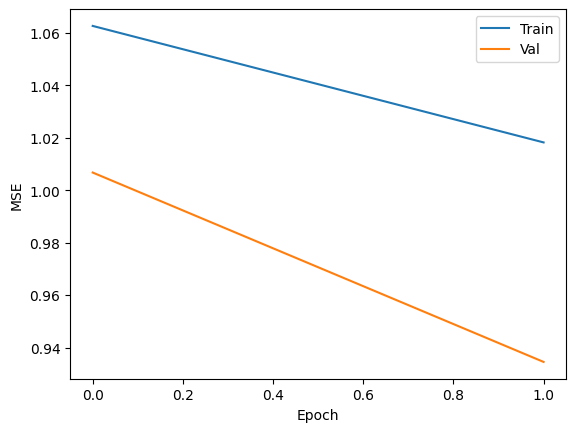
Epoch: 02
        Train Loss: 1.018
         Val. Loss: 0.935

Epoch: 01
        Train Loss: 1.063
         Val. Loss: 1.007


After choosing the best model:
Test Loss: 1.029
Advanced Case
[7]:
# Import tsad deep learning regressors
from tsad.utils.ml_models.deeplearning_regressors import MLP, SimpleLSTM, LSTM
# Get the number of features in the train set for neural network layers settings
k = train_raw.shape[1]
[8]:
# For example we can create objects of deep learning regressors and
# can choose one from the following models:
classic_mlp = MLP([k,k,k,k])
autoencoder = MLP([k,int(k/2),int(k/2),k])
classic_lstm = SimpleLSTM(k,k)
bidirect_lstm = SimpleLSTM(k,k,bidirectional=True)
multilayerLSTM = LSTM(k,k)
[9]:
%%time
#Measure the time taken to execute the pipeline

# We assemble a pipeline of imported tasks for multivariate time
# series deep learning forecasting
pipeline = Pipeline([
    HighLevelDatasetAnalysisTask(),
    TimeDiscretizationTask(freq_tobe_approach='custom',freq_tobe='1s'),
    FindNaNTask(),
    EquipmentDowntimeTask(),
    ResampleProcessingTask(),
    StandardScalerTask(),
    SplitByNaNTask(),
    PrepareSeqSamplesTask(len_seq=10,gap=10),
    DeepLeaningTimeSeriesForecastingTask(),
], show=False)
# Fit the pipeline on the train set
y_pred_train = pipeline.fit_predict(train_raw,n_epochs=2,model=classic_lstm)
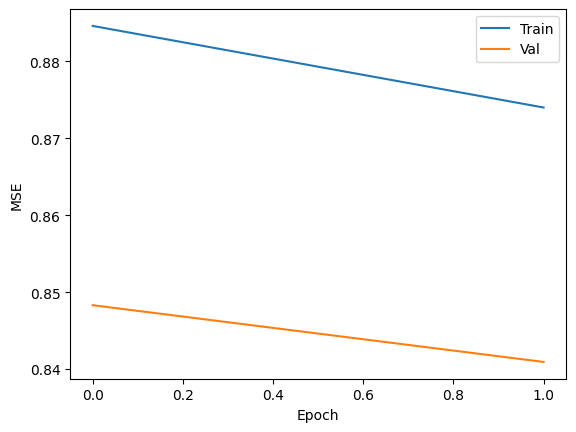
Epoch: 02
        Train Loss: 0.874
         Val. Loss: 0.841

Epoch: 01
        Train Loss: 0.885
         Val. Loss: 0.848


After choosing the best model:
Test Loss: 0.890
CPU times: total: 2.34 s
Wall time: 2.35 s
Inference of pipeline
[10]:
y_pred = pipeline.predict(test_raw)
Skipped 125 datasets because the number of samples is too small in the dataset. (len_seq + points_ahead + gap -1 <= len(df))
Getting y_true
[11]:
raw_pipeline = Pipeline([
    HighLevelDatasetAnalysisTask(),
    TimeDiscretizationTask(freq_tobe_approach='custom',freq_tobe='1s'),
    FindNaNTask(),
    EquipmentDowntimeTask(),
    ResampleProcessingTask(),
    StandardScalerTask(),
    SplitByNaNTask(),
    PrepareSeqSamplesTask(len_seq=10,gap=10, test_size=0,what_to_shuffle='nothing')])
_, _, y_true, _ = raw_pipeline.fit_predict(test_raw)
Skipped 125 datasets because the number of samples is too small in the dataset. (len_seq + points_ahead + gap -1 <= len(df))
Comparing results
[12]:
from sklearn.metrics import mean_squared_error as rmse
[13]:
print(rmse(y_true=np.array(y_true).ravel(), y_pred=np.array(y_pred).ravel()))
0.9624337469659863
[ ]: